Contents
The five failure modes
Power resistors in industrial drives, EV chargers, energy-storage inverters and rail traction systems do not fail at random. After twenty years of returns analysis we see the same five mechanisms again and again — and they appear in remarkably stable proportions across customers, climates and power ratings. The point of this guide is to give a reliability engineer a single page that ties each mode to its underlying physics, to the standardised test that reproduces it, and to the design decision that prevents it.
The headline number to remember: open-circuit failure dominates. Field data published in the DSIAC resistor & capacitor failure-mode survey and the U.S. Navy NSWC SD-18 resistor failure handbook confirm what most reliability programmes already see in their own return streams: wirewound and metal-element resistors almost always die open, while film products skew toward drift. Short circuits are rare enough that many engineers have never seen one in twenty thousand fielded units, but when they do happen the consequences are disproportionate.
| Parameter | Open-circuit | Drift | Short | Mechanical | Thermal runaway |
|---|---|---|---|---|---|
| Field share | ~65–75% | ~15–20% | <2% | ~8–12% | <1% |
| Root cause | Wire fatigue from thermal cycling; weld degradation | Oxidation, moisture ingress, electromigration | Carbon tracking, conductive bridging, foreign matter | Vibration, mounting torque error, shock | Overload exceeding hot-spot rating |
| Detection signal | Resistance → ∞ ; downstream circuit dead | ΔR/R drift >1% from initial measurement | Resistance → 0; OCP/fuse trip | Visible crack, smell, intermittent contact | Char marks, discoloration, melted housing |
| Prevention | Derate to ≤50%; limit ΔT cycle; oversize wire | Hermetic / conformal coat; control hot-spot | UL94 V-0 housing; creepage ≥4 mm | Calibrated mounting torque; vibration spec | Thermal fuse; current limit upstream |
| Reference test | IEC 60115-1 §4.25 (endurance); JEDEC JESD22-A104 | IEC 60068-2-78 damp heat; IEC 60115-1 §4.24 | IEC 60695 glow wire / UL94 arc tracking | IEC 60068-2-6 vibration; -2-27 shock | IEC 60115-1 §4.27 short-time overload |
1. Open circuit (the most common)
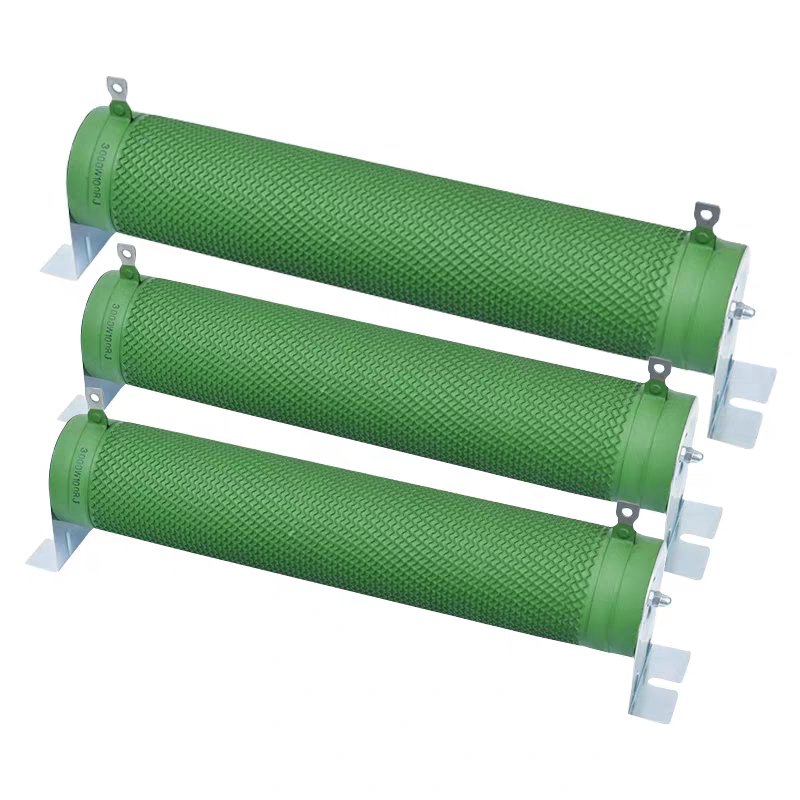
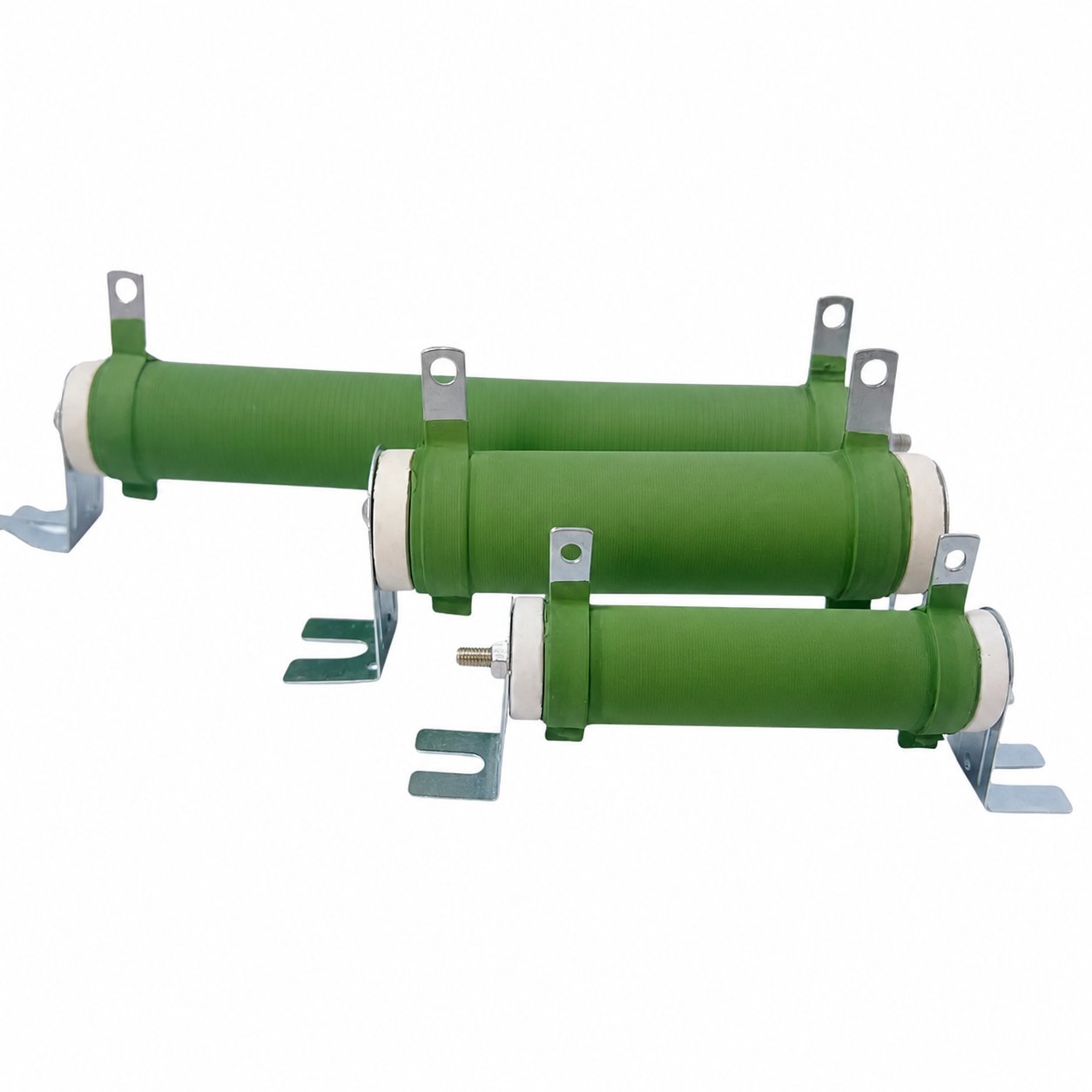
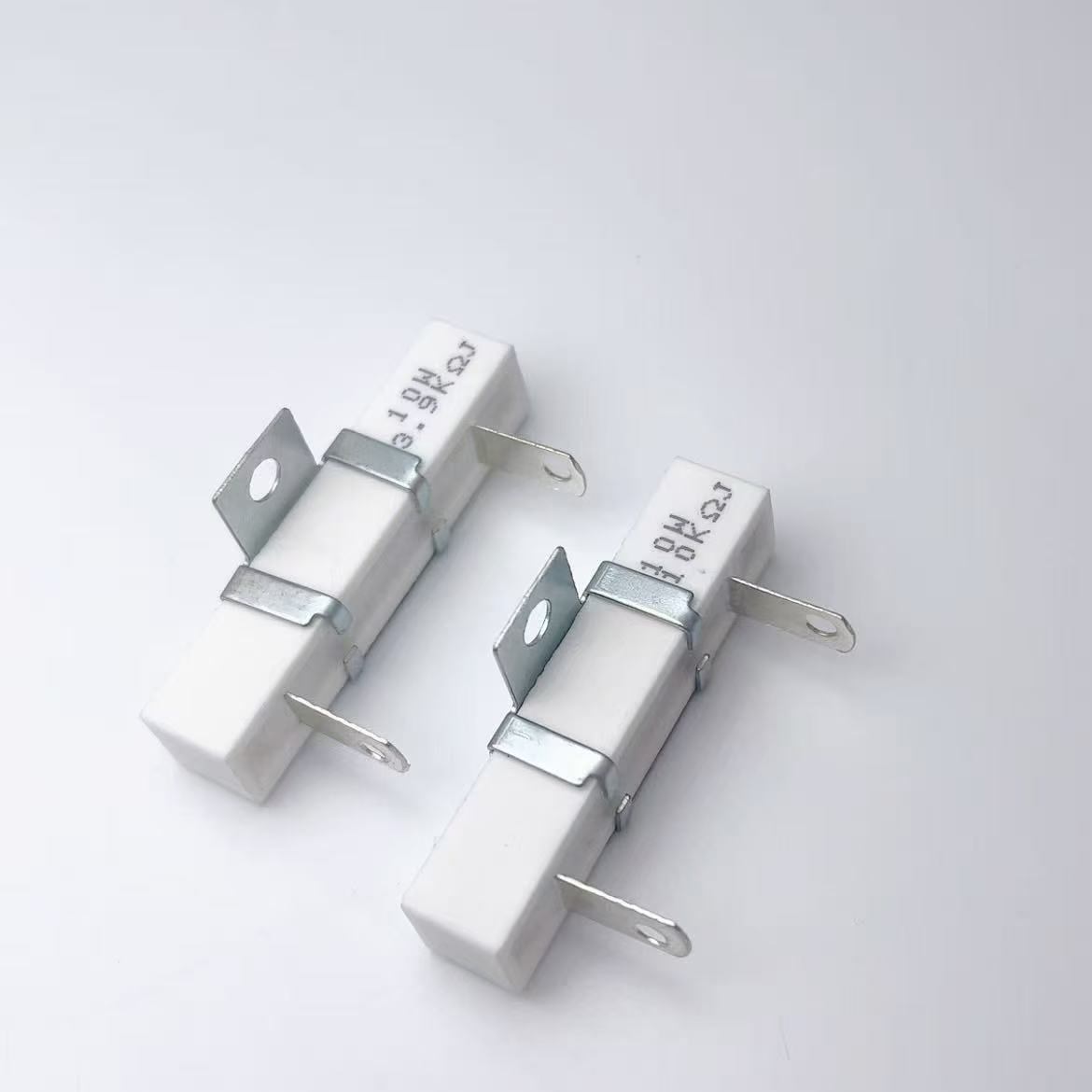
Physics. The resistance element — typically a nickel-chromium, copper-nickel (CuNi44) or iron-chromium-aluminum alloy wire wound on a ceramic core — expands and contracts each time the resistor heats up and cools down. At a 5 kW braking duty, a 50 W cement resistor can swing 200 °C in seconds. Each cycle work-hardens the wire and propagates micro-cracks at grain boundaries; eventually the crack runs the full cross-section and the wire snaps. The same mechanism breaks the welds at the tinned-copper end caps where the resistance wire meets the lead frame; in fact, weld-zone failure is the more common variant because the heat-affected zone of the weld is metallurgically weaker than the parent wire.
How it presents. Resistance reads infinite on a DMM. The downstream circuit is dead — a VFD braking chopper throws an over-voltage fault, a pre-charge resistor leaves the DC bus uncharged, a discharge resistor fails to bleed a bus capacitor and the next service technician gets a 600 V surprise. On rare occasions the wire breaks but the ends remain close enough to arc intermittently; the failure then looks like a resistor that "works sometimes" which is the worst possible diagnostic signature.
Test method. The endurance test in IEC 60115-1 clause 4.25 runs the resistor at rated power for 1,000 hours at 70 °C ambient — passing requires ΔR/R below 3% and zero open circuits. For thermal-cycling-dominated applications (everything that pulses), the relevant test is JEDEC JESD22-A104 temperature cycling, condition G (-40 °C to +125 °C), 500–1,000 cycles, monitoring continuity in-situ. We use the in-situ monitor specifically to catch intermittent opens that disappear when the part returns to room temperature.
Mitigation. Derate continuous power to 50% of nameplate and the wire fatigue rate drops by roughly an order of magnitude. Specify a larger wire diameter than the minimum ohmic value would require — every extra 0.1 mm of wire diameter buys roughly 3–5× more thermal cycles. For pulse duties, choose a part whose pulse energy rating exceeds the worst-case single shot by at least 2×, and use the manufacturer's ΔT-per-pulse chart, not the steady-state power rating, to bound design life.
2. Resistance drift
Physics. Drift is the slow walk of resistance value away from its initial measurement, usually upward. Three mechanisms drive it in power resistors. First, surface oxidation of the alloy wire — every kelvin above 200 °C accelerates oxide growth, and oxide skin has lower conductivity than the parent alloy, so the effective cross-section shrinks. Second, atomic diffusion at solder joints and weld interfaces, which changes the metallurgy of the contact and adds a few milli-ohms. Third, in cement-housed parts, moisture absorbed by the cement binder shifts the leakage-resistance path; this is reversible if the part is baked but permanent if the moisture has caused intergranular corrosion of the wire.
How it presents. Initially nothing — the resistor still functions. Then a precision shunt that started at 1.000 mΩ reads 1.012 mΩ a year later and the current-sense loop reports 1.2% low; or a balance resistor in a battery stack drifts by 0.5% and cells stop balancing within tolerance. For power-dissipation applications drift is usually benign until it reaches 5–10%, at which point the resistor often transitions into open-circuit territory because the same oxidation that raised resistance has also weakened the wire.
Test method. The classical damp-heat test is IEC 60068-2-78 (85 °C / 85% RH for 1,000 h). For accelerated steady-state drift, IEC 60115-1 clause 4.24 specifies 1,000 hours at rated power and maximum body temperature; ΔR/R is measured every 250 hours and plotted versus log-time. A well-designed wirewound shows a slope <0.1% per decade of hours; a poor design or undersized wire shows a slope that accelerates after roughly 500 h, which is the warning that the population will exit the drift mode and start failing open.
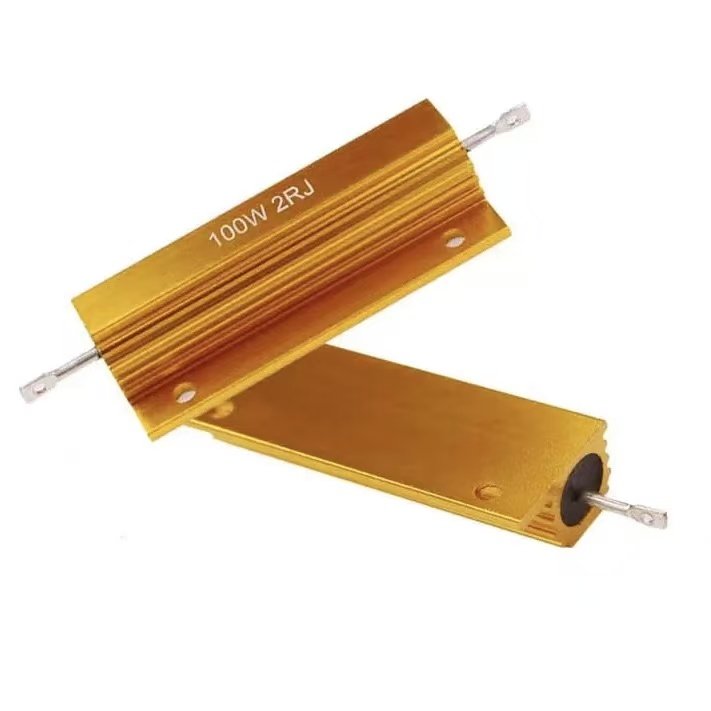
Mitigation. Run the wire cooler. Hot-spot temperature is the single most influential variable: every 10 °C reduction roughly halves the drift rate, the same Arrhenius behaviour we will revisit in the lifetime section. For sub-0.1% precision applications use bifilar-wound, hermetic packages; for industrial power-dissipation applications the cheaper route is generous derating combined with conformal coating to slow moisture ingress. Aluminum-housed products with a properly applied silicone potting compound resist drift far better than open-frame cement at the same nominal power.
3. Short circuit (rare but catastrophic)
Physics. A power resistor short-circuits when a conductive path forms between its two terminals other than through the resistance element. The two principal mechanisms are carbon tracking across a degraded insulating surface — a slow process driven by repeated micro-arcing under high-voltage stress — and foreign-object bridging, in which a metal chip, solder ball or settled conductive dust lands across the leads. Cement-housed designs are statistically more vulnerable because the cement binder can carbonise under repeated discharge events, leaving a permanent low-impedance track. Glass-enamel and silicone-coated wirewound surfaces carbonise much less readily.
How it presents. The resistor reads near-zero ohms. Upstream protection trips immediately if the design is sound — a DC-link pre-charge resistor that shorts will draw full bus current, dump that current into whatever fuse or contactor sits upstream, and produce a loud thump and burning smell. If no protection is present (a depressingly common design omission), the energy goes into the resistor body itself, which can rupture, ignite, or vent hot plasma. This is why we treat short-circuit failure as the highest-severity mode even though it accounts for less than 2% of returns.
Test method. Surface-tracking resistance is assessed by IEC 60112 Comparative Tracking Index (CTI); we require CTI >400 V on every housing material that sees line voltage. Glow-wire flammability is IEC 60695-2-11 at 850 °C, and resistance to arc-tracking falls under UL94 V-0. For end-product testing, IEC 60115-1 clause 4.27 short-time overload (6.25× rated for 5 s) reveals whether overload tendency is open or short.
Mitigation. Pick a housing material with CTI ≥600 V and UL94 V-0 rating for any resistor across more than 60 V DC. Provide creepage and clearance per the relevant insulation-coordination standard — for traction systems that means EN 50124. Add an upstream fuse sized to interrupt the worst-case fault current; for safety-critical balance and discharge paths add a thermal cut-off bonded to the housing — UL2231 EV-charging discharge circuits effectively require this.
4. Mechanical failure
Physics. Mechanical failures cover cracked housings, broken mounting brackets, snapped leads, loosened terminals and fractured solder joints. Vibration is the dominant driver in mobile applications — rail traction, EV drivetrains, wind-turbine pitch systems — where 5–500 Hz sinusoidal vibration plus random broadband noise act on a part with a non-trivial mass. Resonance is the killer: a wirewound rod resistor mounted by both end caps has a first flexural mode in the 50–200 Hz range, exactly the band that traction-converter vibration profiles excite.
How it presents. Visible cracks in the cement body, hairline fractures in lead wires near the strain relief, loosened M5/M6 terminal nuts on aluminum-housed parts. The electrical signature is usually intermittent — resistance is correct when stationary, opens when vibrated, returns when at rest. Vibrating the assembly with a rubber mallet during fault isolation will reproduce it in seconds.
Test method. Sinusoidal-vibration endurance per IEC 60068-2-6 (test Fc) at 10–500 Hz, 5 g, 2 h per axis. Shock per IEC 60068-2-27, 50 g, 11 ms half-sine, 18 shocks. For traction specifically, EN 61373 category 1B applies, and it is considerably more demanding than the generic IEC profile — we test traction-grade resistors to category 2 to leave headroom.
Mitigation. Use mid-span mounting clamps or double-sided brackets on long wirewound elements to push the first resonance above the application's excitation band. Apply specified mounting torque with a calibrated wrench — 3 N·m for M4 aluminum-housed terminals is typical, and over- torque cracks the ceramic substrate while under-torque lets the joint vibrate loose. Use spring washers under terminal nuts. For high-vibration environments specify potted aluminum-housed designs over cement; the resin damps the element and the housing distributes load.
5. Thermal runaway
Physics. Power resistors do not have the textbook positive-feedback thermal runaway of bipolar transistors, but they exhibit a near-equivalent failure when local hot-spots accelerate the local TCR. For most alloy wires TCR is positive (NiCr ≈ +85 ppm/°C, CuNi44 ≈ +20 ppm/°C); on first principles this is stabilising. The problem is geometric: if part of the wire runs hotter than the rest — because of a local convection-blocked spot, cement crack, or air gap from potting void — that section dissipates more power per unit length, gets hotter still, and the resistance contribution from the rest of the wire dominates the lower-resistance surrounding cool zones so the localised heating cannot be self-limited by the bulk TCR. The hot spot races to wire melting temperature (≈1,400 °C for NiCr) in seconds.
How it presents. Localised char marks on the housing, sometimes a single bright spot visible through a translucent cement coating. Resistance after the event is usually open (the hot-spot melts through), occasionally short if the molten metal bridges adjacent windings. Many returns we receive show classic single-spot scorch patterns, unmistakable once you have seen one.
Test method. Short-time overload per IEC 60115-1 clause 4.27 (6.25× rated, 5 s) and pulse-energy endurance per the manufacturer's pulse curve. For our designs we add a single-pulse destructive test at 10× rated for 1 s on lot samples; the failure mode under that pulse is a quick way to verify there are no manufacturing voids inside the potting. Infrared thermography during steady-state operation at 1.2× rated reveals hot-spots invisible at nameplate power.
Mitigation. Specify continuous duty at ≤50% of nameplate, keep peak duty within the manufacturer's pulse curve with a 2× margin, and add a thermal cut-off bonded to the housing for safety-critical applications. For aluminum-housed designs verify void-free potting on incoming inspection — even small voids dramatically raise local thermal resistance and seed hot-spots.
Estimating lifetime — Arrhenius model
The Arrhenius equation relates reaction rate to absolute temperature; applied to electronic-component aging it predicts that lifetime decreases exponentially as temperature rises. For the dominant resistor failure mechanisms — wire oxidation, weld diffusion, polymer aging in housings — an activation energy of roughly 0.7 eV holds well enough to make the popular "10 °C rule" a useful first approximation: lifetime halves for every 10 °C rise in hot-spot temperature. The JEDEC dictionary entry for the Arrhenius reliability equation and the published discussion in Electronics Cooling magazine both note this is a rule of thumb, not a universal law — it breaks down for mechanisms driven by thermal cycling rather than steady-state temperature, which is exactly why we treat the Arrhenius prediction and the JESD22-A104 thermal-cycling test as complementary tools, not substitutes.
Simplified 10°C rule:

    L₂ = L₁ × 2^((T₁ − T₂) / 10)

where
    L₁ = rated lifetime at hot-spot temperature T₁ (°C)
    L₂ = expected lifetime at hot-spot temperature T₂ (°C)
Worked example. A wirewound rated 50,000 hours at 100 °C hot-spot is installed in an enclosure where measured hot-spot is 120 °C. Substituting into the formula:
    L₂ = 50,000 × 2^((100 − 120) / 10)
       = 50,000 × 2^(−2)
       = 50,000 × 0.25
       = 12,500 hours
A 20 °C rise on a hot summer day in a poorly ventilated cabinet has cost three-quarters of the design life. Inversely, dropping the hot-spot from 100 °C to 80 °C — usually achievable with a heatsink, a stand-off, or a 30% larger resistor — buys a 4× lifetime extension, well past the 100k-hour goal that industrial and traction customers ask for.
| Parameter | 60 °C | 80 °C | 100 °C (rated) | 120 °C | 140 °C |
|---|---|---|---|---|---|
| Multiplier vs rated | 16× | 4× | 1× | 0.25× | 0.0625× |
| Estimated lifetime | 800,000 h | 200,000 h | 50,000 h | 12,500 h | 3,125 h |
| Years (24/7 duty) | 91 y | 23 y | 5.7 y | 1.4 y | 0.36 y |
For more rigorous predictions consult IEC 61709 (which assigns a default Arrhenius activation energy of 0.7 eV to fixed resistors and applies temperature, electrical and quality factors), MIL-HDBK-217F Notice 2 (which gives explicit failure-rate models per resistor style with πT, πS and πQ factors), and Telcordia SR-332 (the commercial equivalent widely used in telecom, medical and ESS designs). All three give similar order-of-magnitude answers when applied honestly; the differences emerge in tightly-tailored, low-volume designs and matter mostly for warranty-cost models, not first-pass selection.
Design rules for 100k-hour MTBF
Pulling the previous sections together, here are the ten rules we apply to any new industrial design where the customer asks for 100,000-hour-plus MTBF. None of them are surprising; collectively, they are the difference between a part that lasts ten years in service and one that returns in eighteen months.
- Derate continuous power to ≤50% of nameplate at the application's worst-case ambient. Derating is by far the most powerful single lever — it pays back in lower hot-spot temperature, lower drift, lower fatigue rate.
- Keep hot-spot temperature ≤100 °C for 100k-hour designs. Measure it; do not trust calculation alone. A thermocouple bonded to the resistor body during full-load commissioning is twenty minutes of effort that saves field returns.
- Specify the pulse curve, not the steady-state rating, for any application where the duty is non-continuous. Pulse capability is set by the wire's thermal mass, not by the housing's convection — they are different limits with different curves.
- Use non-inductive bifilar windings for frequencies above 10 kHz. Standard wirewound presents tens of μH that ruin high-frequency snubber, filter and dummy-load performance.
- Add a thermal fuse bonded to the housing of any resistor in a safety-critical path (DC-link discharge, pre-charge, battery balance). The fuse converts every failure mode into a benign open.
- Pick housings with CTI ≥600 V and UL94 V-0 for any resistor across more than 60 V. Insulation coordination errors are the most common cause of the rare short-circuit fires.
- Mount with calibrated torque. Over-torque cracks ceramic; under-torque leaves a vibrating joint that fails mechanically. Specify the torque on the assembly drawing.
- Verify first resonance is above the application band for any vibration-exposed mounting. Use mid- span clamps on long elements; verify with a sine sweep on the first prototype.
- Screen 100% with an overload pulse before shipment when end-application reliability matters. 5× rated for 5 s plus before-and-after DC resistance flags infant-mortality parts; ΔR/R >0.5% is our reject criterion.
- Re-test after any process change — new cement batch, new wire supplier, new potting compound. Run an abbreviated IEC 60115-1 endurance plus JESD22-A104 thermal cycling on the first 100 units. The standards exist so you can run a meaningful sample in a few weeks instead of waiting two years for field data.
For additional background see the IEEE Reliability Society publications, the Wikipedia entry on the Arrhenius equation for the underlying physical chemistry, and the manufacturer application notes referenced throughout this article. Our own wirewound, aluminum-housed and cement product families are characterised against IEC 60115-1, JESD22-A104, IEC 60068-2-6 and IEC 60068-2-78; the qualification reports are available on request for any series under design-in evaluation.
Frequently asked questions
What's the most common failure mode for power resistors?
How does a resistor fail short instead of open?
What's a realistic MTBF for industrial power resistors?
How does Arrhenius estimation work for resistors?
Can I extend resistor life by adding a heatsink?
What test methods detect early-life failures?
References & further reading
- IEC 61709 — Reliability prediction for electronic components
- MIL-HDBK-217F — Reliability prediction of electronic equipment
- JEDEC JESD22 — Test methods for thermal cycling
- Vishay — Resistor reliability (white paper)
- Arrhenius equation — physical basis
- Telcordia SR-332 — Reliability prediction procedure for electronic equipment
- IEEE Reliability Society — failure analysis resources